Flat Roof Leak Repair in St. Petersburg, FL
When severe weather strikes St. Petersburg, rapid emergency response is critical to protect your building substrate, interior finishes, and personal property from water damage.
RoofExpertUSA dispatches independent Florida Certified Roofing Contractors (CCC) equipped for immediate Flat Roof Leak Repair throughout St. Petersburg and Pinellas County.
Local St. Petersburg Crews
Dispatched locally for rapid arrival across all St. Petersburg residential and commercial corridors.
Florida Building Code Compliance
Engineered methods meeting high-velocity hurricane zone and 140+ mph wind uplift standards.
Insurance Mitigation Support
Complete before-and-after photo documentation formatted for Florida property insurance claims.
Call for Immediate Dispatch: (888) 208-4155
Call (888) 208-4155 now to request priority dispatch in St. Petersburg.
1. Pinellas Peninsula Coastal Dynamics, Tropical Storms & Flooding
Positioned on a low-lying peninsula surrounded by the open waters of Tampa Bay to the east and the Gulf of Mexico to the west, St. Petersburg and Pinellas County face extreme microclimate exposure. Tropical storms, convective squalls, and hurricane-force wind bands funnel unhindered across coastal waterways, driving moisture under roof eaves, lifting unsealed shingles, and subjecting flat roof additions to intense hydrostatic ponding pressures.
Salt-laden marine air accelerates the galvanic corrosion of steel roofing fasteners, step flashings, and valley liners. When 60 to 90+ MPH wind shear sweeps across coastal neighborhoods like Snell Isle, Old Northeast, Shore Acres, and Tierra Verde, corroded nails and oxidized flashing clips shear off, allowing tile courses and perimeter metal edge flashing to lift and expose raw underlayment to horizontal wind-driven rain.
2. Non-Destructive Thermal Moisture Diagnostics & FLIR Infrared Tracing
Water intrusion across Pinellas Peninsula properties frequently travels extensive horizontal distances before revealing itself inside living quarters. Rain penetrating a wind-damaged barrel tile ridge or a cracked plumbing boot collar on a 4:12 pitch roof tracks down plywood sheathing seams and attic rafters, emerging decades later through ceiling drywall twenty feet away from the original puncture.
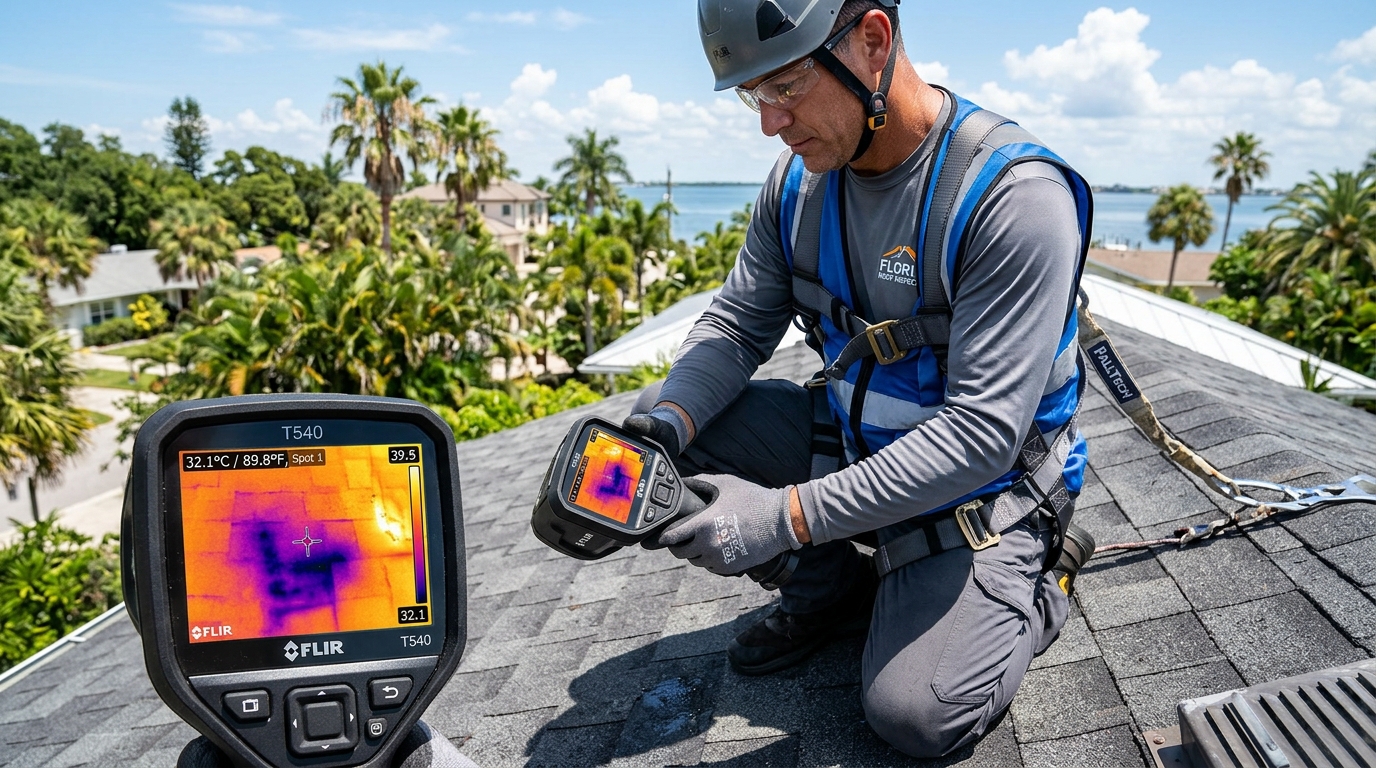
Dispatched independent Florida Certified Roofing Contractors (CCC) utilize calibrated FLIR infrared thermal imaging radiometers and electronic impedance moisture meters. Wet fiberglass batting, saturated polyisocyanurate roof insulation, and waterlogged wood decking retain heat differently than dry building materials during evening cool-down cycles. Non-destructive thermographic scans delineate the exact boundaries of active moisture intrusion beneath shingles, tiles, and flat roof membranes without unnecessary demolition.
3. Step-by-Step Code-Compliant Substrate Restoration Methodology
All emergency stabilization and permanent roofing repairs performed across St. Petersburg must satisfy the stringent requirements of the Florida Building Code (8th Edition, 2023) Chapter 15 and Residential Chapter 9. Dispatched crews adhere to engineered mitigation protocols tailored for coastal wind and moisture stress:
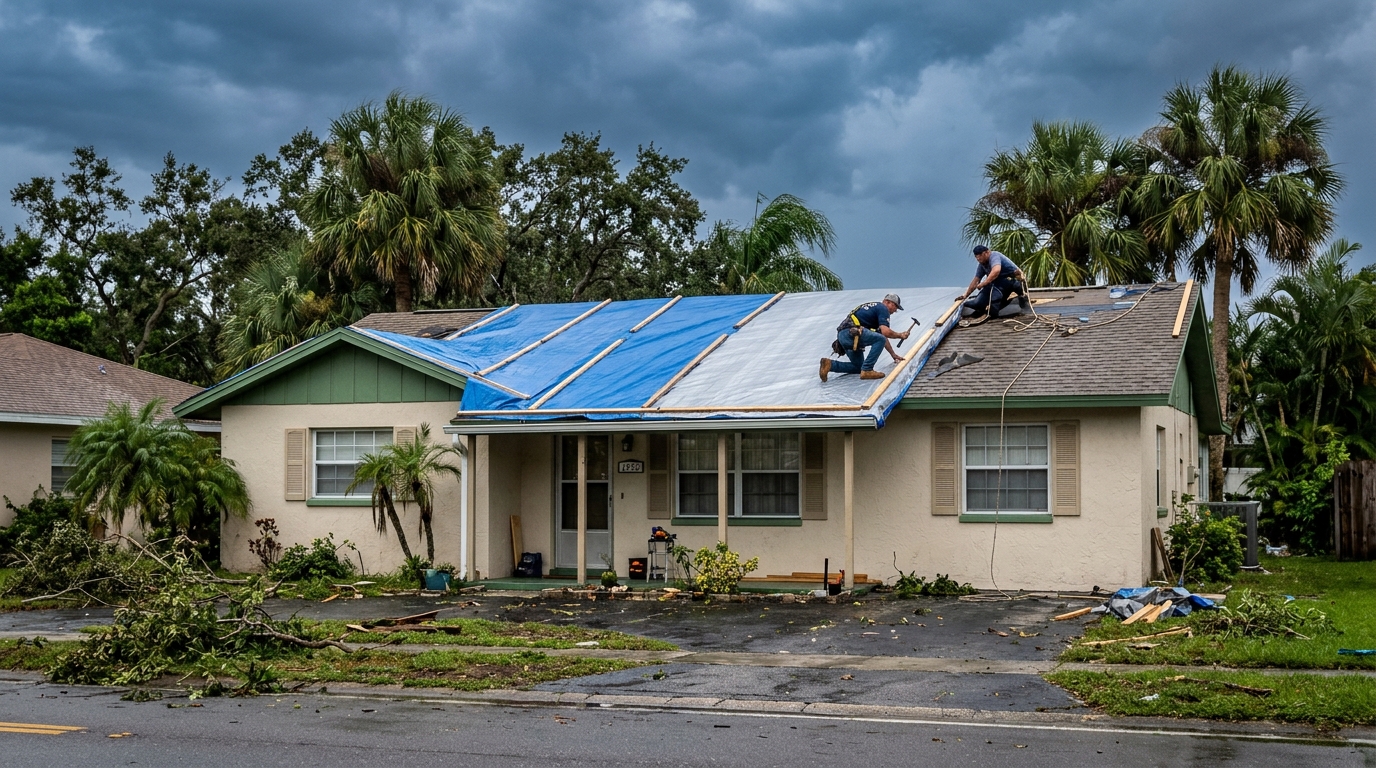
- Immediate Structural Hazard Containment: Deploying industrial timber-battened 12-mil poly tarps secured into rafters with wood furring strips, avoiding blind mechanical penetration through sound field tiles or shingles.
- Ponding Deck & Flat Roof Drainage Restoration: Removing standing water from low-slope flat roofs, unclogging debris-choked scuppers and internal drains, and applying reinforced elastomeric or modified bitumen emergency patches.
- Substrate Sheathing Inspection & Replacement: Replacing water-softened or mold-compromised 5/8" CDX plywood or OSB decking with APA-rated exterior plywood fastened with 8d ring-shank nails at 6" edge / 6" field spacing.
- Secondary Water Barrier Application: Applying ASTM D1970 self-adhering high-temperature polymer-modified bitumen underlayment directly to bare decking for complete self-sealing secondary protection.
- Mobile Home Membrane Resealing: Applying specialized fleece-backed EPDM or TPO patch membranes with high-tack butyl adhesives to restore manufactured home roof envelopes against coastal wind peel.
4. Florida Building Code Wind Uplift Standards & DBPR Contractor Licensing Compliance
Pinellas County is classified under Florida Building Code wind uplift criteria requiring roofing assemblies to withstand basic design wind speeds ranging from 140 to 150 MPH (Risk Category II), with higher exposure thresholds along coastal barrier islands. Drip edge metal must have minimum 3-inch roof deck flanges with staggered 4-inch mechanical fastening, and tiles must be secured with code-approved mechanical screws or two-component polyfoam adhesives.
Under Florida Statute § 489.127, performing roofing construction or contracting without an active Certified Roofing Contractor (CCC) or Registered Roofing Contractor (RC) license issued by the Department of Business and Professional Regulation (DBPR) is a first-degree misdemeanor, elevated to a third-degree felony during a declared state of emergency. RoofExpertUSA connects consumers strictly with credentialed, insured Florida contractors possessing active DBPR licensing, workers' compensation, and comprehensive general liability policies.
5. Preventative Property Maintenance & Severe Storm Preparedness in Pinellas County
Given St. Petersburg's extended June-through-November Atlantic hurricane season, proactive roof maintenance is critical for protecting property value and complying with insurance loss-mitigation duties. Homeowners and commercial facility managers should schedule semi-annual certified inspections to identify brittle shingles, cracked mortar beds on tile ridge caps, and split caulking around plumbing flashings before severe storm fronts arrive.
Keeping overhanging live oak and laurel tree canopies pruned back at least ten feet from rooflines prevents heavy limb drops and reduces leaf accumulation in roof valleys and gutter systems. For flat roofs and low-slope lanai additions common throughout St. Pete, regular clearance of scuppers and downspout strainers eliminates dangerous ponding weight that compromises roof structural integrity.