St. Petersburg Active Water Intrusion Triage Protocol
When tropical storm bands or afternoon squalls penetrate your roof assembly, seconds matter. Follow these field-tested stabilization steps before our emergency crew arrives.
Relieve Ceiling Bulges Immediately
If drywall ceilings begin to sag or pocket water, place a 5-gallon bucket underneath and pierce the center with a screwdriver. Draining trapped rainwater relieves structural load and prevents catastrophic ceiling failure across rooms.
Isolate Breakers & Electrical Risers
Wind-driven rain commonly travels down electrical conduits, recessed lighting housings, and attic chase walls. Shut off circuit breakers serving flooded zones immediately to prevent electrical arcing and structural fire hazards.
Document Damage for Florida Insurance
Capture high-resolution timestamps, photos, and video of active water intrusion, ceiling stains, and saturated carpeting before moving furnishings. This documentation is required by Florida property insurers under Chapter 627.
Call 24/7 St. Pete Dispatch Network
Dial (888) 208-4155. You will be connected directly with an emergency dispatch operator who routes your call directly to an available licensed Florida roofing team in Pinellas County.
St. Petersburg's 4 Primary Emergency Roofing Specialties
Peninsular geography places St. Petersburg between Tampa Bay and the open Gulf of Mexico. Our network specializes in the four most critical emergency roofing vulnerabilities across Pinellas County.
Coastal High-Wind Tarping
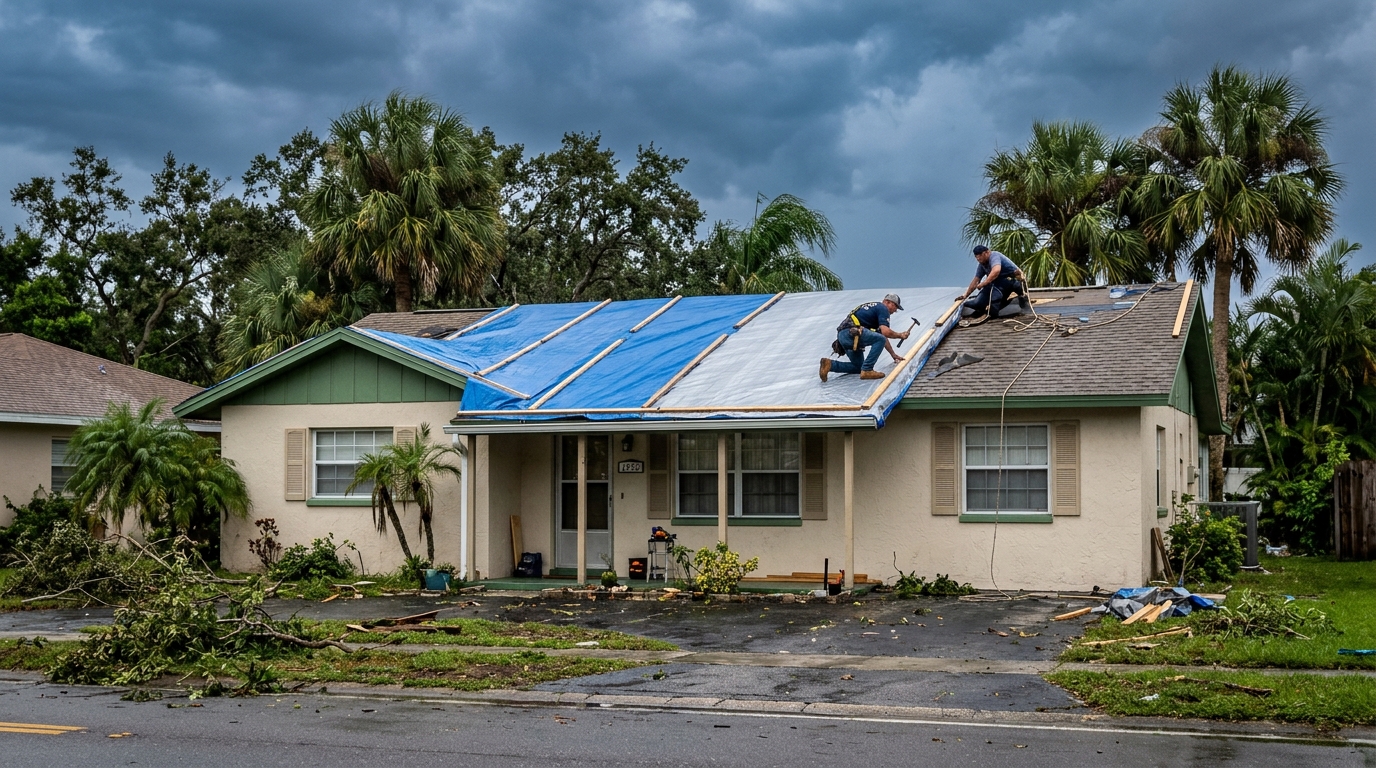
Ordinary tarps tear off within hours in coastal Pinellas winds. Dispatched crews install commercial-grade 12-mil woven polyethylene membranes anchored with exterior 2x2 timber battens screwed into structural trusses, creating a watertight envelope rated for 60+ mph wind gusts.
Learn Tarping Standards →Flat Deck Ponding Water Patch
St. Petersburg historic bungalows, mid-century additions, and commercial properties feature dead-level flat decks vulnerable to standing ponding water. Technicians pump stagnant pools, clean sub-membrane seams, and weld elastomeric emergency mastic patches that cure underwater.
Ponding Triage Solutions →Dislodged Concrete Tile Fix
Pinellas coastal gusts dislodge Spanish 'S' and flat concrete tiles across Old Northeast and Snell Isle. When tiles slip, underlying 30-pound felt underlayment degrades rapidly under UV exposure. Technicians re-seat loose tiles with hurricane-rated polyfoam adhesive and flashing seals.
Tile Stabilization Guide →Mobile Home Membrane Roof Patch
Manufactured home communities across Pinellas Park, Largo, and Seminole utilize aluminum pan roofs and rubberized membrane overlays. Tropical winds peel bow-string edges and seam transitions. Dispatched contractors apply scrim-reinforced thermoplastic liquid seals.
Mobile Home Leak Triage →Why St. Petersburg Roofs Face Extreme Coastal Weather Pressures
St. Petersburg occupies the southern tip of the Pinellas Peninsula, flanked by the salty expanses of Boca Ciega Bay, Tampa Bay, and the Gulf of Mexico. This unique geography creates distinct atmospheric and architectural challenges that standard roofing practices from inland Florida fail to address:
Gulf vs. Bay Microclimates
Winds converging from both bodies of water collide directly over Pinellas County, triggering rapid-onset microbursts, horizontal wind-driven rain, and sudden thermal shock that fractures aging roofing shingles.
Salt-Air Metal Degradation
Marine aerosol chlorides accelerate oxidation of standard galvanized steel drip edges, valley liners, and roofing fasteners within 3 miles of the shoreline, causing concealed fastener failure during high-wind storms.
High-Velocity Wind Uplift
The Florida Building Code designates Pinellas County within the 140–150 mph ultimate design wind speed zone. Rake edges, ridge caps, and hip intersections experience severe negative pressure suction during tropical storms.
Historic Bungalow Architecture
Historic neighborhoods like Old Northeast, Kenwood, and Snell Isle feature complex multi-pitch roofs with intersecting dead valleys, dormers, and low-slope porch transitions that trap storm debris and water.
5-Phase St. Petersburg Emergency Roof Mitigation Process
When you call our 24/7 dispatch line, independent licensed roofing crews follow a standardized, code-compliant protocol designed to stop active leaks immediately and preserve structural decking.
Rapid Telephone Triage
Our live operator documents roof type (tile, shingle, flat deck, metal, mobile home), current leak severity, attic access status, and Pinellas address to dispatch the closest equipped crew.
FLIR Thermal Tracing
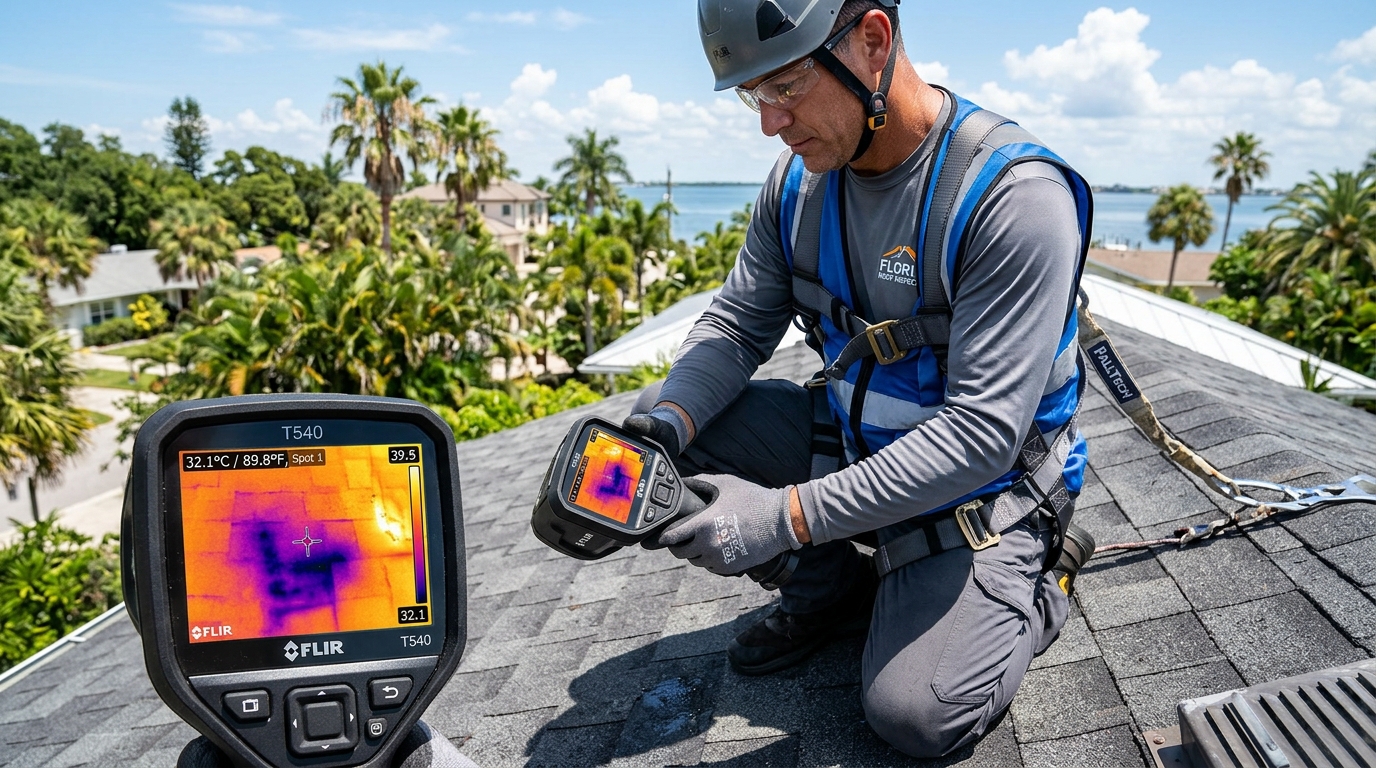
Contractors conduct non-destructive moisture diagnostics using high-resolution infrared imaging and dielectric moisture meters to trace hidden moisture pathways behind rafters and underlayment.
Timber-Batten Tarping
Heavy-duty commercial UV-stabilized tarps are fitted tightly over damaged ridges and slopes. Kiln-dried 2x2 spruce battens are fastened with ring-shank screws to resist coastal shear winds.
Substrate Stabilization
Where plywood or tongue-and-groove decking is rotted or structurally compromised, temporary 5/8-inch CDX plywood plates are installed beneath the membrane to prevent structural sag.
Insurance Documentation
The responding crew generates a detailed photo audit, thermal moisture report, and line-item scope of emergency work formatted for Florida homeowner insurance claims and adjuster review.
Pinellas Peninsula Emergency Service Areas
From the historic brick streets of St. Petersburg to the coastal shores of Clearwater, our referral network connects homeowners with rapid emergency roofing response teams across Pinellas County.
Clearwater & Coastal Hub
Specialized coastal wind triage, high-velocity tile repair, and commercial flat roof waterproofing along Clearwater Beach, Downtown Clearwater, and Countryside.
Largo & Central Pinellas
Fast emergency dispatch across Largo, Belleair, and High Point. Rapid mitigation for residential shingles, flat patio roof additions, and storm damage.
Pinellas Park & Lealman
Manufactured home community roof specialists and commercial warehouse flat roof triage across Pinellas Park, Kenneth City, and mid-peninsula commercial zones.
Dunedin & Safety Harbor
Covering North Pinellas Sound communities, historic Dunedin, and Safety Harbor along upper Tampa Bay with emergency tree damage cleanup and cedar shake/tile triage.
Strict Compliance with the Florida Building Code (8th Edition 2023) & DBPR Licensing
Florida law strictly prohibits unlicensed handymen from performing structural roofing repairs. In St. Petersburg and Pinellas County, roofing work is regulated by the Florida Department of Business and Professional Regulation (DBPR) under Chapter 489, Florida Statutes.
Certified Roofing Contractors (CCC)
RoofExpertUSA routes dispatch calls strictly to independently licensed Florida Certified Roofing Contractors (CCC) or Registered Contractors (RC) holding verified workers' compensation and general liability policies.
25% Roof Replacement Rule
Under FBC Existing Building Section 706.1.1, if more than 25% of a roof section is repaired or replaced within 12 months, the entire roofing system must be brought into compliance with current wind-uplift codes.
Permit Exemption for Emergency Tarping
Under Pinellas County emergency mitigation rules, immediate dry-in procedures including timber-battened tarping and leak stabilization do not require advance permits, allowing instant on-site response.
Pinellas Peninsula Material Engineering & High-Wind Systems
Different roofing assemblies behave uniquely under coastal storm pressures. Understanding how specific roofing materials fail allows our dispatched contractors to execute precise, code-compliant emergency repairs.
Architectural Shingle Systems
Under Florida Building Code Section 1507.2, asphalt shingles in Pinellas must comply with ASTM D3161 Class F (110 mph) or ASTM D7158 Class H (150 mph) wind resistance. Dispatched crews use 6-nail high-wind fastening patterns into structural plywood decking, sealing tabs with SBS-modified adhesive to prevent progressive peel-off along rakes and eaves.
Concrete & Clay Barrel Tiles
Spanish 'S' and flat concrete tiles are installed across Old Northeast, Snell Isle, and coastal estates. Mechanical fasteners alone often fail due to salt-air corrosion. Dispatched teams utilize dual-component polyurethane hurricane foam (AH-160) that bonds tile underbellies directly to self-adhering modified bitumen underlayments, exceeding 150 mph uplift resistance.
Commercial Low-Slope Membranes
Dead-level flat roofs on St. Petersburg commercial buildings, condo complexes, and residential patio additions utilize 60-mil TPO or multi-ply SBS modified bitumen. Dispatched technicians locate hidden moisture migration between polyiso insulation boards, pump standing ponding water, and thermally fuse virgin membrane patches with robotic hot-air welders.
Manufactured Housing Systems
Mobile homes throughout Pinellas Park and Largo utilize lightweight bow-string trusses and curved aluminum radius eaves. High winds pull j-rail perimeter termination bars free, allowing water to track into wall cavities. Dispatched specialists install heavy-duty aluminum termination bars with neoprene fasteners and apply scrim-reinforced elastomeric seals.
Non-Destructive Moisture Tracing & FLIR Infrared Radiometry
Visual roof inspection alone cannot detect water trapped beneath intact shingles, concrete tiles, or commercial roof insulation. Dispatched independent contractors utilize calibrated FLIR infrared thermal cameras to measure subtle evaporative surface temperature differentials. As trapped moisture evaporates, it cools slower than dry surrounding substrates, creating distinct thermal signatures on the infrared spectrum.
Zero Structural Destruction
Thermal diagnostics eliminate the destructive practice of blindly tearing off intact shingles or drilling invasive test holes into roof decking.
Tracing True Ingress Paths
Infrared imaging traces horizontal moisture paths traveling down rafters, valley lines, and electrical conduits from distant entry points.
Insurance Claim Verification
Thermal radiograms provide objective, timestamped forensic proof of water intrusion required by Florida property insurance adjusters.
St. Petersburg Emergency Roofing FAQ
Answers to frequent homeowner questions regarding emergency dispatch, insurance claims, and storm tarping across Pinellas County.
How quickly can a tarping crew reach my home in St. Petersburg?
Emergency dispatch calls are routed immediately to on-call licensed roofing contractors stationed across Pinellas County. During active tropical storms or post-hurricane conditions, crews are dispatched in order of life safety and property vulnerability.
Will my homeowner insurance cover emergency roof tarping?
Yes. Most standard Florida property insurance policies (including Citizens Property Insurance Corporation) obligate homeowners to make reasonable and necessary repairs to mitigate further damage. Emergency tarping costs are typically reimbursed under the policy's mitigation coverage.
Why are sandbags or cinder blocks unacceptable for roof tarping?
Placing heavy loose objects like bricks or sandbags on a steep-slope roof creates extreme safety hazards. When wind gusts exceed 40 mph, unanchored tarps catch air like sails, hurling heavy objects through windows or roofs below. Dispatched crews use engineered timber battens screwed into decking rafters.
What types of roofs can your dispatched contractors repair?
Our network covers all common Pinellas County roofing systems: architectural asphalt shingles, clay Spanish tiles, flat concrete tiles, commercial low-slope membranes (TPO, EPDM, Modified Bitumen, PVC), metal standing seam panels, and manufactured mobile home membrane systems.